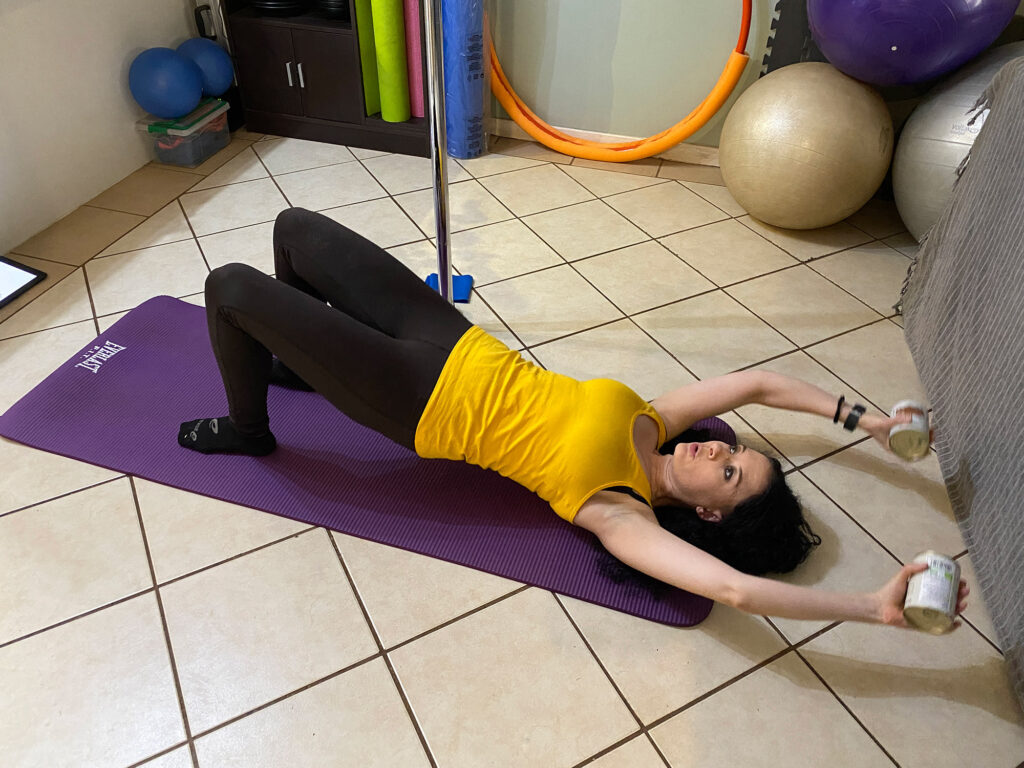
“A man is as young as his spinal column.” – Joseph Pilates
When we align our spine to its correct neutral position, it is believed that we should be able to reach an optimal level of health. Joseph Pilates developed his practice of Contrology (Pilates) with this as one of the key principles. Having suffered various ailments as a child, he transformed his body through exercise to be fit enough to pose for anatomical charts.

Joseph Pilates at age 57 and age 82.
Image source: lifespanpilates.com
Similarly, if the body is out of alignment, isn’t it possible that this not only leads to postural problems, but to other health issues as well?
The elements of posture and alignment, and how we incorporate these into our Pilates practice, has held my fascination for quite some time. When I fell ill recently, it was through my own mind-body awareness that I became even more focused on postural corrections that would further assist me with a speedy recovery, and general health going forward.
Disclaimer: This article is a recollection of my own experience and is not designed to diagnose or treat any medical conditions. If you are experiencing pain or discomfort, it is advisable to seek help from a medical professional.
My Experience with Shingles
It’s Just a Hip Spasm..
There is so much we can learn by “listening” to our bodies. If we pay attention and observe, our bodies will guide us to understand what is wrong, and we can correct the root of the problem. Instead, we mask aches and pains with medication, only discovering deeper underlying problems when it’s too late.
Mind-body connection is something that we learn in exercises such as Pilates, dancing and martial arts. We learn to understand which aches are good and which are bad. We learn how different parts of the body move, and how they are linked to the rest of the body.
Mind-body connection is especially important when we experience pain or discomfort, or when we fall ill.
I had a reminder of this lesson with a recent experience over December. What was meant to be a short, relaxing break from my crazy, active lifestyle turned out to be nearly 3 weeks of agonising pain and sleepless nights.
It started out as a mild hip spasm. Now, I often have odd little aches in and around the same hip. They come and go, and if they do linger for longer, I add some stretching to my regular routine to ease any discomfort.
So, when I started experiencing a shooting pain in the same hip, I didn’t think much of it. It didn’t stop me from my regular activities. I performed in a dancing show, taught Pilates classes, and still took part in an Aerial Silks class, all whilst experiencing this pain between activities.

Although I had been experiencing intense pain, it didn’t show up while I was performing my regular activities, such as dancing or Aerial Silks, so I thought it couldn’t be that bad.
Photo taken at The Cirk. Photographer: Vivian Danielle Coetzer, Bloom Photography
But this was not the regular muscle ache or pain that I could ease up with a few stretches. Still, the pain did not appear at all while I was performing exercises. I was only experiencing it between activities – especially whilst sitting or lying down. It is for this reason that I still didn’t think much of it at the time – I can still move and dance, right?! Therefore it can’t be that bad.
Well, that was only the beginning..
“Pain is one of life’s greatest teachers….”
Okay, maybe it’s more than just a hip spasm..
Over the next day or two, the pain came and went. I developed a weird pins-and-needles type of feeling below my knee, which only showed up at night. I thought this was odd, but again I didn’t think much of it. Yet..
However, by about the 4th day, the pain started to become unbearable. When I stood up or walked, I was perfectly fine (except for a shooting pain now and then), but as soon as I had been sitting or lying down for too long, I was in complete agony. See?! Sitting really is bad for us!
By the evening of day 4, I couldn’t bear the thought of lying down to sleep. I tried. I grimaced. I whined. My husband decided it was time for an intervention, and took me to the hospital ER to get this pain beast checked out.
Now, as you know, we’re in the midst of a global pandemic. I was quite hesitant to go to a hospital, but the pain had me close to tears and truly unable to sleep.
After answering some questions, getting x-rays taken, and receiving a script for pain meds, I was sent on my way.
X-Rays can teach us so much about our bodies
I’ve always been fascinated by x-rays. My parents both had back operations when I was younger, and I recall marveling at the x-rays they had received post-op, showing surgical corrections – nuts, bolts and screws that kept bones in place.
Needless to say, I’m even more fascinated when I see x-rays of my own skeleton. By knowing what is happening inside the body, we’re able to adapt and correct alignment issues more easily.
Although I know that I have a misaligned coccyx (tailbone), I wasn’t convinced that the pain I was experiencing was related to this. But I wasn’t going to say no to having photos of my spine taken!
“If your spine is stiff at 30, you are old. If it is flexible at 60, you are young.” – Joseph Pilates
From the x-rays taken, the doctor confirmed – no issues were visible in my spine that could be causing the pain. The only notable remark was that there was a degeneration in 2 of my lumbar vertebrae, and I also noticed a slight lateral curvature in my upper thoracic spine. New knowledge about my spine excites the anatomy geek in me, as it means I have in-depth information on what to focus on during my exercise routines and activities.

On the left, the more natural alignment of the tailbone. On the right, mine. This has always caused me to sit in odd, awkward positions. Entertaining as these may be to see, this in turn led to problems in my lumbar spine. More recently, I learnt that I had mild degeneration in my lumbar vertebrae, most likely cause by years of bad posture whilst sitting.
Anatomy image source: medicalnewstoday.com
Next up, Physio..
When my hip pain initially started, and I still suspected this was a pinched nerve due to the pins and needles I had felt, I had booked an appointment with a physiotherapist.
The physio gave me a number of exercises to assist with mobility in my lower back, as well as some exercises to help strengthen and align the muscles around the hip. This was on the 5th day after I had first started experiencing hip pain.
But by the following day, I was in even more pain, and was hardly able to do any of the prescribed exercises. As a Pilates instructor and fitness enthusiast, this was just becoming more and more frustrating with each step!
Then, I had to remind myself: “What is your body trying to tell you? What do we know so far?”
- Hip spasms, feeling almost like a pinched nerve
- I was still able to move. I danced, I did aerial classes, I exercised. Sitting and lying down were problematic.
- A pins-and-needles feeling developed, which is related to the nervous system.
- Excruciating shooting pain, from my back down my leg.
Then came the final piece in the puzzle..
Wait, what are these spots..?
This is the part where I really started paying attention to what my body was trying to tell me, and the crucial point in reaching the final diagnosis.
Around day 7, I started noticing spots, similar to a rash, but far more spread apart than a rash would generally be. I do have a sensitivity to the sun, and initially I thought I was getting a mild heat rash from spending too much time in the garden.
But I started to realise that the spots were in the exact same areas where I had been experiencing the pain. Specifically, I’d had a sharp, burning pain in my lower back, and noticed a spot in this exact position. By day 9, this particular spot had created the distinct Shingles type of rash marking: Small bubble-like spots had started forming within the spot. My husband, having had Shingles before, immediately recognized this, and off we went to the doctor once again.
Finally diagnosed! Shingles..
The doctor confirmed that the spots were running along one of the nerve dermatomes. Dermatomes are sensory areas on the skin that follow neural paths.

Sensory dermatomes of the body. Shingles lies dormant in the nerves within the spinal column, and will erupt from a single nerve path. Sensory nerves run from the spine down the body along certain sensory paths, called dermatomes. My outbreak ran along the L4 dermatome, with the rash appearing in my lower back, around my knee, and along my shin.
Image source: healthline.com
So, what is “Shingles” exactly?
Shingles is basically the “grown-ups” version of chickenpox. Once you’ve had chickenpox, the virus stays in your system, and can flare up years later, due to stress or a compromised immune system. The good news is that you can’t get Shingles from someone who has Shingles. However, if you haven’t had Chickenpox, you could get Chickenpox from someone who has had Shingles, but only if they physically touch the rash. (Who would do that?!!)
Luckily, I still had very few spots, and we were able to stop the rash in its tracks. From what I’ve seen and heard, this rash can get incredibly aggressive (don’t Google search “Shingles” images, just don’t!) and the burning sensation I was feeling from just a few spots could have been far worse if these had spread.
Now, being the curious cat that I am, I DID Google “Shingles”, as I wanted to know everything about this virus. That’s when I came across an article which mentioned Shingles may be an effect of “silent Covid”. Sorry, what now?!
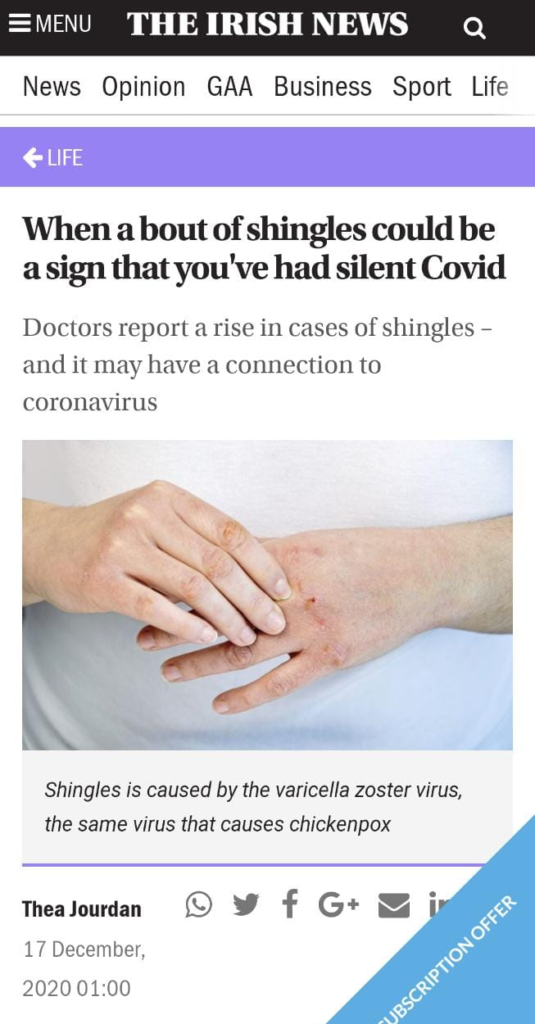
Image source: irishnews.com
So of course, off I went for a Covid test! Result: negative.
Quick Shingles facts:
- Shingles is caused by the same virus that causes Chickenpox.
- Someone with Shingles cannot give Shingles to someone else.
- If you’ve had Chickenpox, the virus lies dormant in the nerves near your spinal cord, and can reactivate as Shingles. It’s unknown what causes this reactivation, but it’s believed that stress or a compromised immune system can trigger this.
- Someone with Shingles can spread Chickenpox to a person who has not had Chickenpox, but this is only through direct contact with the Shingles rash.
- 1 in 3 persons gets Shingles.
- A Shingles vaccine is available, and is generally only given to persons over 50 due to the more serious effects of the virus in older persons.
Shingles bells, shingles bells..
Shingles affects the nervous system. The Chickenpox virus lies dormant in the spine and, when released, it travels down a nerve path. Most commonly, Shingles forms in the upper body. Mine happened to choose the lower, running from one of my lumbar vertebrae, down my right leg.
As mentioned, I was diagnosed in time to stop the rash, but the nerve pain continued, and worsened. I also became quite itchy, not only in the area of the rash along my leg, but also along my arms, chest, and across my back.
Now, the doctor also recommended that I wear loose, light clothing to prevent itching. This however did NOT work for me. Loose clothing moves when you move, and this aggravates itching. Thank goodness for leggings!
Christmas day was day 12 of my crazy experience. Being a sunny summer’s day, I was all too glad to wear a tank top, even though I still had to keep my legs covered. However, I’d hardly been outside for long before the itching on my arms became unbearable. It turns out I had become even more sensitive to sun exposure. (Since I had calamine lotion on my arms, and since we were mostly seated in the shade, I did not think to apply sunblock to my arms. Normally this would not have been necessary under the circumstances.) Where my arms had been exposed to the sun, a red rash similar to sunburn had formed. But after covering up and moisturizing, this had disappeared by the following day. The itching, however, did not.
So that’s how I ended up spending most of my summer covered up in long sleeves and long pants. When I was brave enough to expose my arms again, I made sure to generously apply sunblock. I happened to miss a small spot, and, almost immediately, the redness and itching showed up in the spot I had missed.

This photo was taken in the heat of a sunny South African summer, and shorts and a tank top would’ve been my preferred attire. With Shingles, sun was not kind to me, but walking was. Although I had to avoid sun exposure at all costs, I was grateful to still be able to take regular walks to ease the discomfort caused by Shingles.
Caught in time, but not over yet
As mentioned, I was diagnosed in time to stop the Shingles rash, but the nerve pain continued, and worsened.
Nights were the absolute worst. There was no comfortable position to sit or lie down in. I would sleep for about an hour or two, until either the pain meds had worn off, or the nerve pain had intensified. I would then pace the hallway, up and down. I was basically a zombie – with the outstretched arms, sunken eyelids, and moans and groans to match.
I got creative with sleeping positions – I knelt beside the bed, resting only my upper body on the bed. I lay on my back with my legs up against a wall. I tried to sleep standing, tying myself to my dance pole – this lasted all of 5 minutes. I even attempted an odd kneeling “puppy pose” position on the couch, booty raised, head resting in my arms. This one was surprisingly comfortable, but also only for a short while.
For about a week, our household sleep pattern consisted of shifts. I would wake up and zombie-walk the house, eventually passing out on the couch for an hour or two, before repeating the zombie walk. On other nights, I would be tossing and turning so much in bed, that my husband would move to the couch. (Sorry husband!)
I developed a 2am snack and stretch routine. I would make snacks in the hope that they’d make me sleepy (a hot toddy and a piece of toast, for example). I’d perform mild stretches that would change the pain from agonising to merely uncomfortable. But as soon as I lay down to sleep, my nervous system went back into attack mode.
View this post on Instagram
So back to the doctor we went again! This time, I received medication to calm the nerves. Literally.
Rehab: Neural and general exercises after Shingles
By week 4, the pain had started to ease up. I was finally able to revisit the exercises that the physio had recommended. I also became incredibly interested in the possible root(s) of the problem, and everything I had learnt about my own body in the process. Shingles is generally caused by high stress or a compromised immune system. I still wasn’t 100% convinced that this was the case for me, and I was quite sure that the problem had stemmed from my own body’s attempt to make me aware of an underlying issue: the problem in my lumbar spine.
Had it not been for the initial x-rays that were taken, I would not have known about the degeneration of the vertebrae in my lumbar spine. Knowing about this means that I can take the necessary steps to strengthen and mobilise this area, to prevent further problems. The x-rays also helped me to pinpoint other areas where my spinal alignment can be improved.
Remember: A healthy spine is the fountain of youth!
Shingles also generally forms in the upper body. Mine came straight from the problematic lumbar area and moved down into my leg.
If I had possibly listened to my body even sooner, I may have been able to prevent this – I had experienced mild pain around the same area a few months earlier. A trip to the physio helped temporarily, but even I have to admit that I pushed my body further than it was ready for, without keeping up with the prescribed exercises. Keep in mind that physio exercises lead to improvements in posture, which also need to be incorporated into everyday life.
Whilst Shingles really wasn’t a pleasant experience, I am truly grateful for what I’ve learnt about my body. I even got rid of my office chair and switched to a standing desk setup. Improved posture, here we come!

Standing desk. A step towards improving my posture.
Warmest regards, Bonita.
What is hindering YOUR body and how can I help YOU? Let’s chat! Book a private session or self-assessment, or contact me for a FREE 15-min chat.